MRBD/ Mario Rafael Becerra Dueñas
LocationTürkiye · ready to relocate to Spain · Remote EU
Phone+90 505 941 22 68
LinkedInin/mario-rafael-id-lxd ↗
Emailmrbecerraduenias@gmail.com
CVMario_Becerra_CV.pdf ↓

Mario Rafael
Becerra Dueñas.

Learning Experience Designer, 10+ years in EdTech. I built the curricula at Yandex Practicum, TripleTen and BEAM Institute, and then the tooling those content teams ran on: 4C/ID pipelines, internal automations, an LMS shipped solo.

Recent programs

B2CYandex Practicum 

UX/UI for career switchers
and designers levelling up

Learning Experience Designer

Two tracks came off one curriculum, a full career change and a shorter one for designers already working. A pipeline of designers, developers and reviewers put out a cohort every four to six weeks, with outcomes written against what the industry was hiring for.

Graphic design that ends
in a portfolio defence

Learning Experience Designer

Every unit ended in something a switcher could show: brand identity, editorial layout, packaging, social. Weekly critiques and SME reviews led to a portfolio defence at the end of the track.

Marketing taught on
real client briefs

Learning Experience Designer

Learners worked real briefs from partner companies across performance, content, lifecycle and analytics. Assessments mirrored the tasks a junior marketer gets, and practice was scored against funnel numbers.

B2BTripleTen (Nebius Group) 

Management courses,
rebuilt per client

Learning Experience Designer

Each client got a short course recut from TripleTen's master management curriculum to fit their roles and their business. Some were localised for LatAm, and the video segments ran on HeyGen AI-avatar scripts.

Backend courses cut to
stack and seniority

Learning Experience Designer

Each client's course started from TripleTen's long-form backend program and was cut to their stack and their seniority mix. Where a real codebase was available, assessments were built on it.

Generative AI for people
who don't write code

Learning Experience Designer

Prompt engineering, the AI workflows for a given role, and where the guardrails sit. Each version was tuned to the tools a client already ran and the policies they had to honour.

B2CBEAM Institute 

Data governance, from scratch
with Billigence

Learning Experience Designer · Freelance · project-based

Nothing existed before this one: needs analysis, curriculum architecture, content and QA all ran from zero. Consultants from Billigence, a data-governance firm, kept the regulatory material current.

AI for project managers,
practised on briefs and roadmaps

Learning Experience Designer · Freelance · project-based

The track was written with practising PMs, so it taught where AI belongs in discovery, planning and delivery. Practice ran on their own artefacts: briefs, roadmaps, retros, each rebuilt around an AI workflow.

Consulting · L&DAlgonova 

Teaching an ID team
to build with AI

AI Consulting · L&D · Internal Tooling · Freelance · current

Workshops take the instructional-design team of a K-3 maths platform through AI in content design. Mentoring covers prompt engineering and review pipelines one to one. The tooling comes with it: slide and board generators, autofill userscripts, a lesson-review pipeline, an adaptive-curriculum knowledge graph.

Recent work, selected. 10+ years, 50+ courses, more clients than fit on a page.

Try it yourself

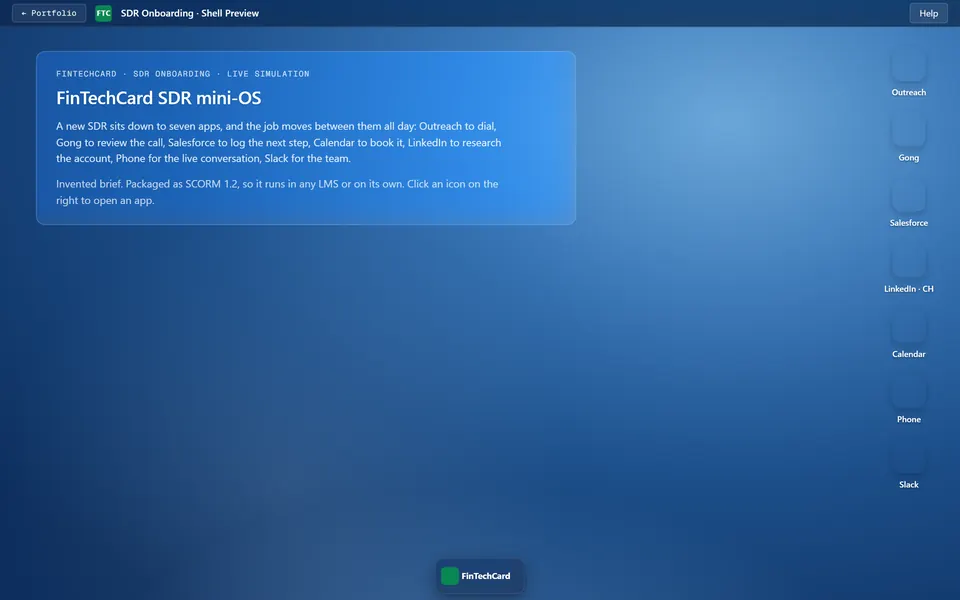
Simulated SDR desktop with Outreach, Gong, Salesforce and Slack in draggable windows

OS simulator

A new SDR's desk, running in the browser: Outreach, Gong, Salesforce, LinkedIn, Calendar, a dialler and Slack, each one a draggable window. Have a look around.

Open the desktop
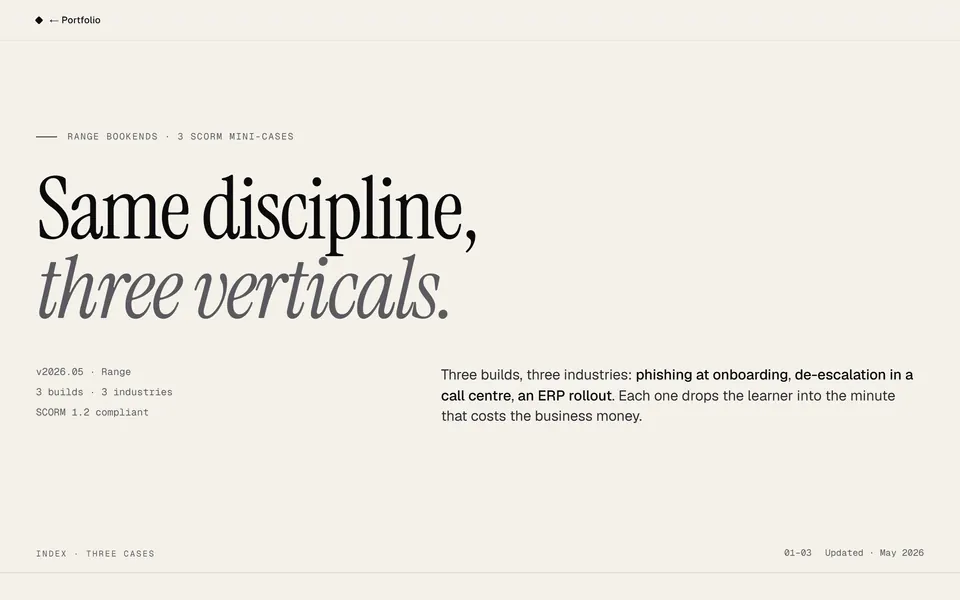
Index of three SCORM mini-cases

Security, de-escalation, procurement

Three SCORM 1.2 packages, one brief each: security onboarding for new hires, de-escalation for a call centre, an ERP procurement rollout. Each runs from the analysis brief to a package you can drop into an LMS.

See all three
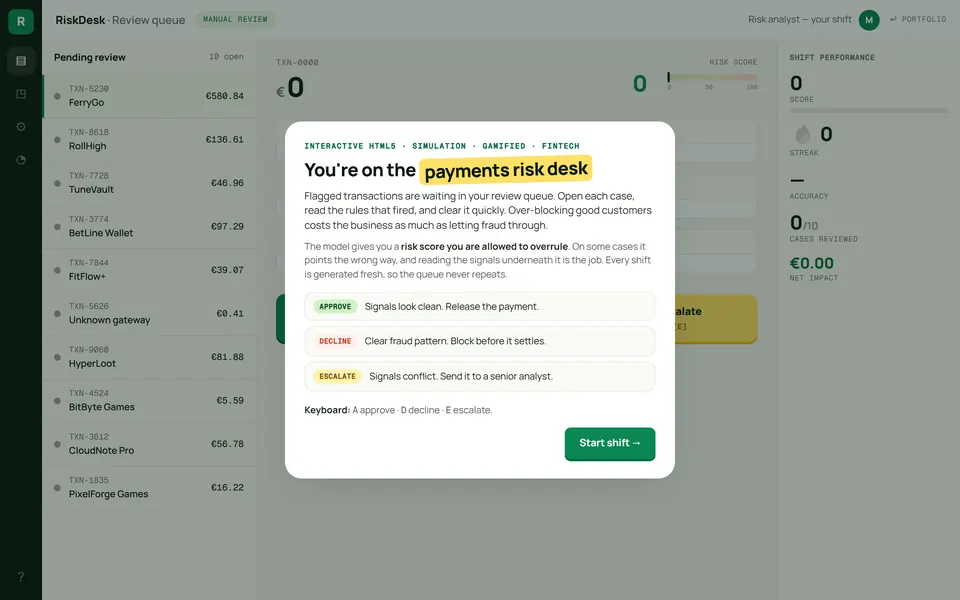
Risk-analyst review queue with flagged transactions and risk scores

A branching fraud queue

A payments risk desk: flagged transactions, a risk score, the rules that fired, and Approve, Decline or Escalate. Every shift is generated fresh, and the model is wrong often enough that you have to read the signals yourself.

Open the queue
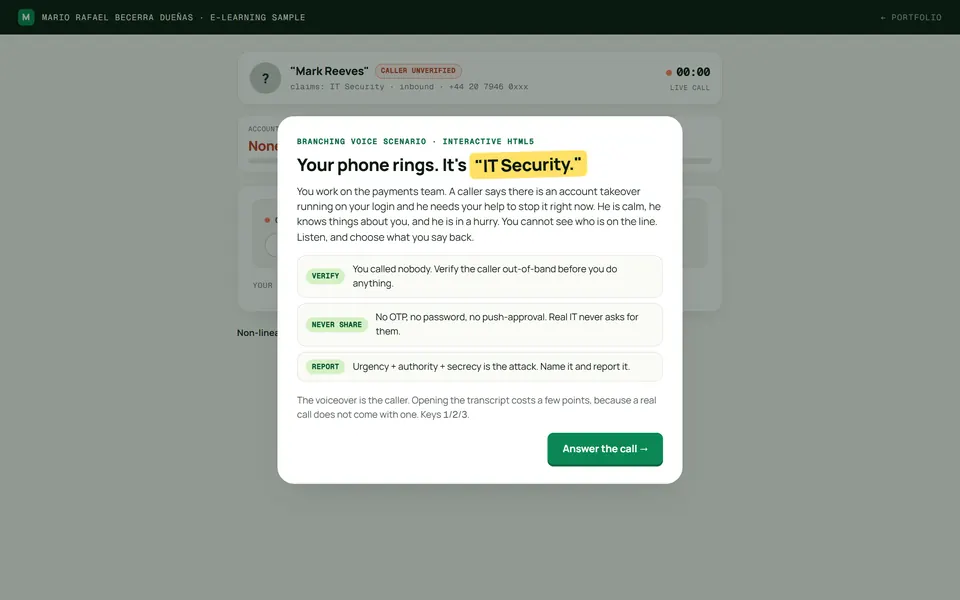
Live vishing call interface with caller panel and branching replies

The caller wants your MFA code

An attacker phones posing as IT Security. He is voiced, your replies branch the call, and his pressure adapts: urgency, authority, threat. Four endings.

Take the call
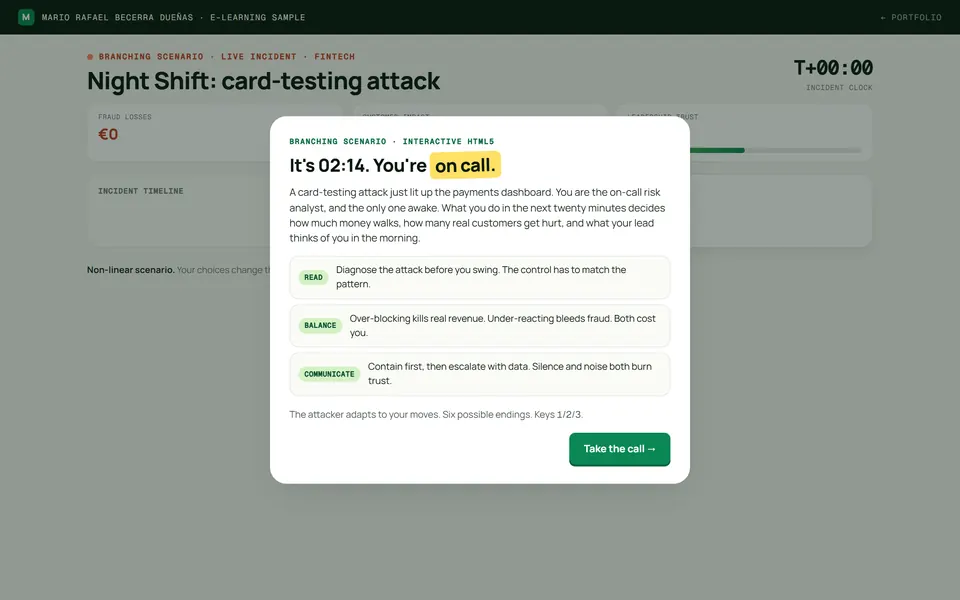
Incident console with clock, fraud-loss meters and response choices

2am on the risk desk

A card-testing attack is running and you are the only analyst on call. Chase the IPs and the bot rotates. Six endings across three live meters: fraud losses, customer impact, leadership trust.

Run the night
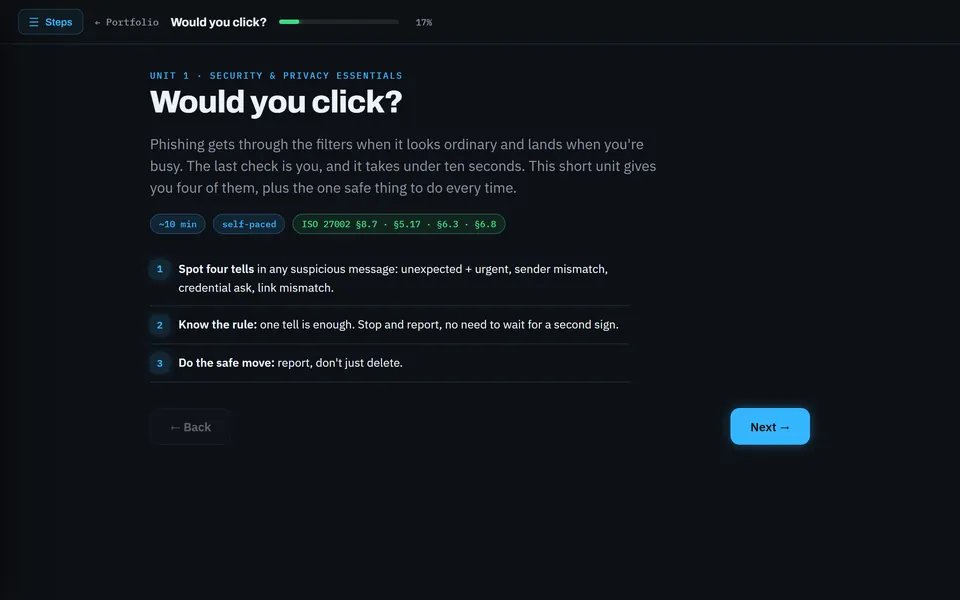
Compliance micro-unit with step rail and progress meter

Boring compliance, rebuilt

Security and privacy awareness, the usual 40-minute deck rebuilt as six self-contained micro-units on a retrieval chain. The case page is the design map; Unit 1 is playable in full, with a 2-minute film, a longread, nine checks and an inbox simulator.

▶ Play Unit 1
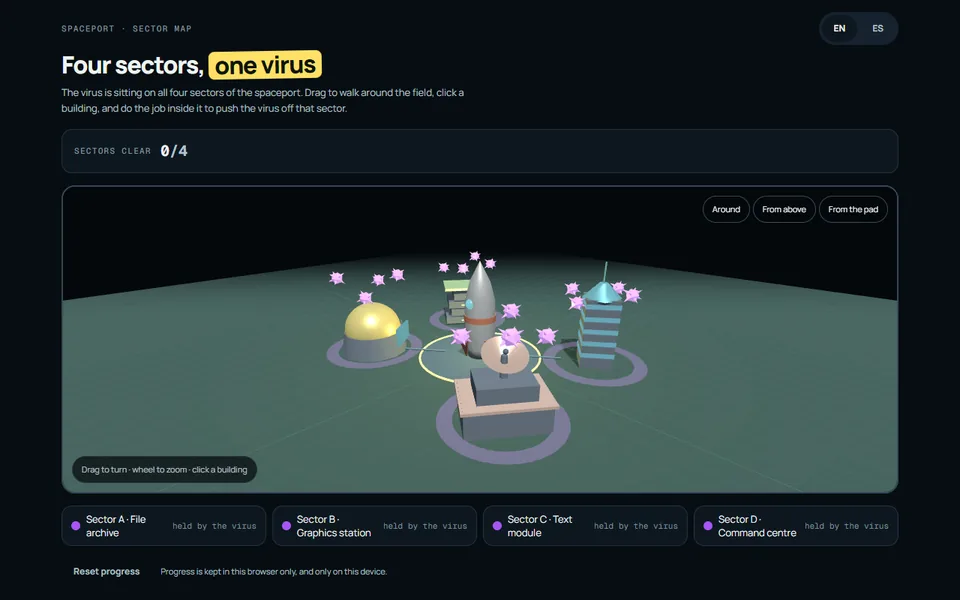
A 3D spaceport seen from orbit, four buildings ringed in purple with the virus sitting on each

A spaceport held by a virus

Fly round the launch field in 3D and pick a building. Each one is held until the job inside it is done, and all four ask for something different: bin the virus files without binning ours, reconnect four wires, hold a purge down while it fights back, pull a lever and keep it there.

Take the field back
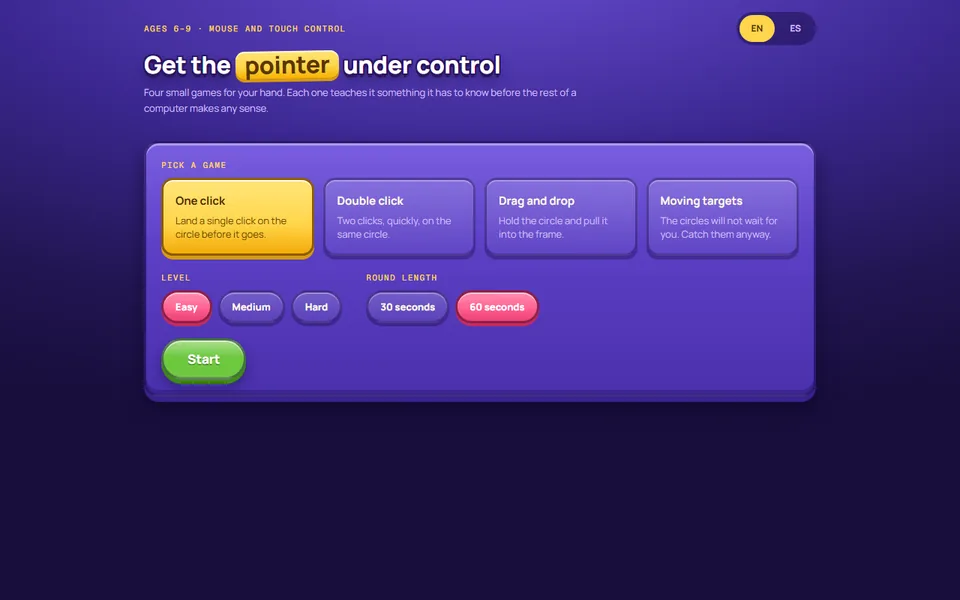
A purple match-three style game screen with four game tiles, difficulty pills and a Start button

Learning to use a mouse

Click, double-click, drag, chase. The four movements a six-year-old needs before any of the rest of a computer makes sense, each at three speeds, scored out of three stars. Dressed as a game because a drill dressed as a worksheet gets opened once.

Play a round
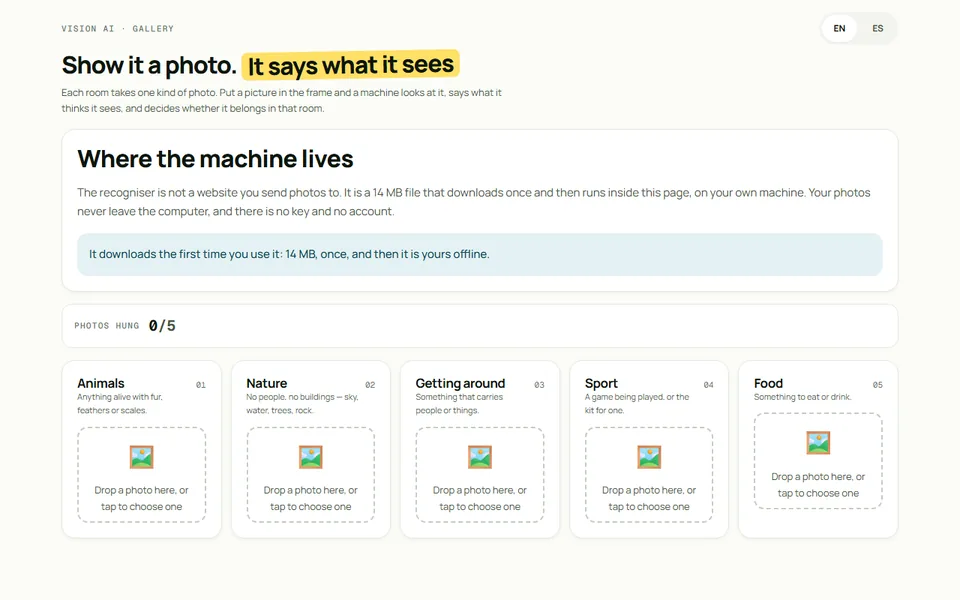
A gallery page where an uploaded photo is named by a recogniser running in the browser

What the machine sees in a photo

Hang a photo in a room and a machine says what it thinks it sees, then decides whether it belongs. The recogniser is MobileNet running inside the page, so there is no account to make and the photo never leaves the computer. It shows its guesses and the score it judged on, so a child can see why it said no.

Hang a photo

Twenty of these live in one place: a Windows file manager, a Chrome tab strip, a Google Docs find-and-replace, a pixel-art canvas. Open the catalogue

GrassLMS
my own LMS

Open the live LMS

A place to run the whole business of teaching, instead of stitching together a video host, a quiz tool and a marking spreadsheet.

Example exercises

Tools I built
for instructional teams

FocusedOne problem · time saved · drop-in

01

The test forms
fill themselves

A Flask backend and a set of Tampermonkey scripts fill matching, categorisation and fill-in-the-blank tests on the teacher-training platforms. Each instructional designer gets back about five hours a week that used to go into clicking.

highlights
  • Flask + Tampermonkey
  • Matching · categorisation · fill-in
  • ~5h / wk saved per ID
~5h/wk ↓
02

Homework collected
in Telegram

The bot pushes homework prompts into Telegram, collects what comes back and lays it out for instructors in a triage view. Learners stay in the app they already have open.

highlights
  • Telegram Bot API
  • Submission triage view
  • No new platform for learners
03

A maths deck in
fifteen minutes

The add-on carries the branded template, a catalogue of layouts and a custom maths font into Google Slides. A deck that took two hours now takes about fifteen minutes, and it still comes out on brand.

highlights
  • Branded template + layouts
  • Custom math font
  • 2h → 15 min per deck
85%time ↓
04

JSON in,
finished deck out

Hand it a lesson-plan JSON and it returns a Google Slides deck already on the branded template. The layout step disappears, so a designer opens the file and goes straight to the content.

highlights
  • JSON → branded deck
  • Layouts & brand pre-applied
  • Pairs with lesson-plan output
2h → 15mper deck
05

Branded boards straight
into Miro and Figma

Structured input goes in and the tool draws the board in Miro or Figma over the API, whether that is a workshop canvas, a lesson canvas or a retro. Brand config and layouts live inside it, so two teams asking for the same board get the same board.

highlights
  • Python + Miro / Figma APIs
  • Brand config + layouts
  • Workshop / lesson canvases

PipelineMulti-step systems · raw sources in, finished artefact out

06

K-3 maths as a
graph of skills

A knowledge graph holds the skills of K-3 maths and the observable objectives sitting under each one. It feeds the diagnostic, the BKT mastery estimate, and the lesson a given learner gets next.

highlights
  • 45 modules · 212 topics
  • ~200 skills (G1–G3)
  • BKT · lesson assembly
212topics
07

Where the ID team
looks things up

The dashboard catalogues lesson assets, tracks what has been reviewed and keeps the methodology references where the curriculum team can reach them. MCP endpoints expose the same data, so AI tools read from what the team reads from.

highlights
  • Lesson asset catalogue
  • Review-state pipeline
  • MCP endpoints for AI tools
08

Every complaint about a lesson,
in one queue

Slack threads, Notion comments, mentor rubrics and post-cohort survey CSVs all land in one place, and recorded lessons are transcribed alongside them. The pipeline normalises the lot into an issue database the QA team can work through.

highlights
  • Sources → normalise → DB
  • Transcription of recorded lessons
  • Triage-ready for QA team

What I offer

01 AI pipelines that grade their own output A brief goes in, the model drafts, a second model scores that draft against a rubric, and only passing work publishes. Retries and drift detection sit inside the loop. 60–85% content time ↓
02 Small tools, one problem each Userscripts, slide and board generators, autofill, Telegram bots. Each one takes out a single recurring job. ~5h / wk per ID
03 Curriculum built as a skill graph Skill graphs with observable objectives underneath, and a BKT model tracking mastery. That structure is what lets a platform pick the next lesson for a given learner. 212 topics · ~200 skills
04 Teaching ID teams to work with AI Workshops, one-to-one mentoring, and prompt systems the team can reuse. Designers keep making the calls. current at Algonova
05 Whole programmes, analysis to eval Analysis, design, build and evaluation, run through ADDIE or 4C/ID. Solo, or alongside subject-matter experts. 9 programs · Yandex / TripleTen / BEAM
06 EdTech platforms, shipped solo Database, backend, frontend, billing, deploy, all of it by one person. GrassLMS is the reference build. 80+ features · shipped solo